







Has Your Insurer Shortchanged You on a Written Off Vehicle?
Posted on 10 June 2026 by Cory Waterworth
If your car has been written off and you accepted the insurer’s first offer, you may not have been paid what your vehicle was actually worth. Here is what the rules say, and how to tell if you were shortchanged.
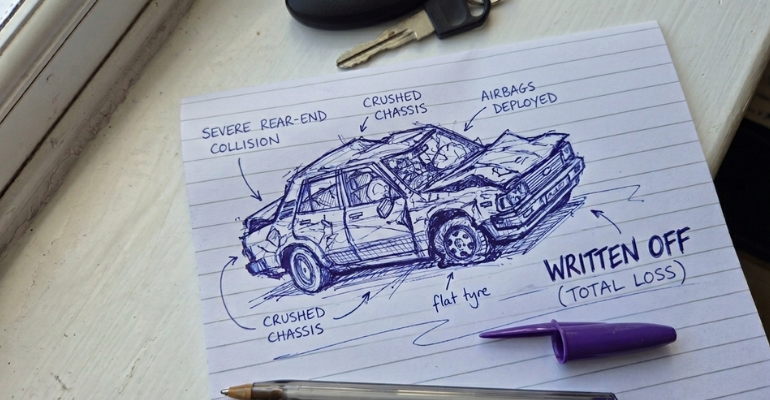
What Happens When a Vehicle Is Written Off?
When a car is too badly damaged to repair, your insurer will typically keep the vehicle and pay you a cash settlement. That settlement should reflect what your car was worth immediately before the incident. Insurers call this the pre-accident value.
Think of it like pressing a pause button one second before the write off. What would a buyer have reasonably paid for your car at that exact moment? That is the figure your insurer should be basing your settlement on, taking into account your car’s make, model, age, mileage and condition.
Selling a car privately usually involves some haggling. You might not expect the same from a professional insurance company. But insurers are making a judgement call on your car’s value, and that judgement is not always a fair one.
How Should a Vehicle Be Valued?
The Financial Ombudsman Service (FOS) is the independent body that resolves disputes between consumers and financial firms. It has set out clearly how it expects vehicle valuation disputes to be handled. FOS will look at everything on the file: engineer comments, motor trade guide valuations and even advertisements for comparable vehicles.¹
The Ombudsman does not rely on a single source. It draws on as many trade guides as possible. Where valuations vary significantly, it may disregard outliers or take an average. The overriding principle is that the outcome must feel fair.¹
That is the standard the Ombudsman applies. It does not follow that your insurer has applied the same standard. Some insurers have not consulted all the trade guides the Ombudsman would consider. Others have used data that did not reflect true market values at the time of your write off.
A Volatile Second Hand Car Market
The used car market has been far from stable in recent years. The pandemic and the global semiconductor shortage both reduced the supply of new vehicles. Together they pushed second hand car prices up sharply, by around 2% in 2020 and by more than 30% in 2021.²
That kind of volatility creates a real risk for you as a consumer. Vehicle values do not just shift from year to year. They can change significantly within a single month.²
If an insurer bases your settlement on last month’s trade guide data, your payout may fall short of what you would actually need to buy a comparable replacement. Derren Martin, Director of Valuations at cap hpi, noted in 2022 that vehicle values were changing constantly within the month, adding enormous strain to the market.² Without real time data, claims handlers risk offering settlements that do not reflect the true market.²
Advertised Prices: Closer to Selling Prices Than You Might Think
Insurers sometimes argue that advertised prices are “asking prices, not selling prices.” The implication is that buyers always negotiate the price down. Historically, there may have been some truth in that. But the market has shifted.
The Ombudsman has observed that cars are increasingly selling at or very close to their advertised prices, with much less room for negotiation than in the past.³ A separate Ombudsman decision from the same year reinforced the point, noting that it is now common knowledge that cars sell much more often at the advertised price.⁴
This matters. If your insurer is still applying a blanket discount to advertised prices on the assumption that buyers negotiate, it may be undervaluing your vehicle.
Trade Guide Divergence and the Highest Guide Approach
The Ombudsman has acknowledged that motor valuation guides now show a wider range of values than they used to. In a 2024 decision, the Ombudsman stated that it now expects insurers to pay the highest of the trade guide valuations. The insurer must provide evidence if it wants to justify a lower figure.⁵
That is a significant expectation. Not all insurers may be meeting it.
Should You Challenge Your Settlement?
If your vehicle has been written off and you think the settlement was too low, consider whether your insurer:
- consulted all of the relevant motor trade guides, not just one or two
- used valuation data that was current at the date of your write off, not data from the previous month
- properly accounted for the fact that second hand cars now sell much closer to their advertised prices
- paid the highest of the trade guide valuations, or gave evidence to justify a lower figure
If any of those steps were missed, you may have been shortchanged. You could be entitled to additional compensation. Our vehicle write off claims page explains how to check.
Think your insurer got it wrong? At Allegiant, we specialise in helping customers who may have been undervalued on a written off vehicle. Get in touch today to find out whether we can help.
Disclaimer: This article is for general information only. It does not constitute financial or legal advice.
Regulatory: Allegiant Finance Services Ltd is authorised and regulated by the Financial Conduct Authority (FCA). FRN 836810.
¹ Financial Ombudsman Service, Decision DRN-3058492, 30 September 2021.
² Solera Audatex, “Market Value Manager Offers Live Data Streams”, 21 June 2022.
³ Financial Ombudsman Service, Decision DRN-3380101, 18 March 2022.
⁴ Financial Ombudsman Service, Decision DRN-3631961, 9 August 2022.
⁵ Financial Ombudsman Service, Decision DRN-4839406, 9 August 2024.